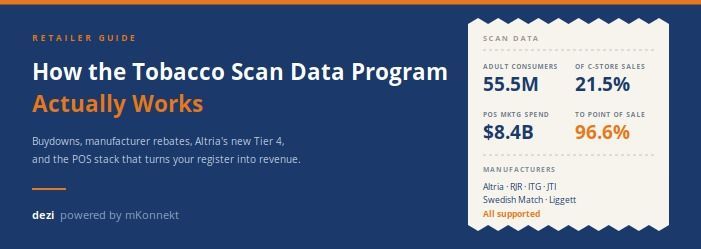
Tobacco Scandata Program Evolution
Tobacco scandata has changed significantly over the past decade. What began primarily as a way to capture transaction-level sales, validate manufacturer-funded promotions and support retailer reimbursement is gradually becoming part of a broader customer engagement ecosystem.
That evolution has not happened in isolation. Tobacco manufacturers have fewer traditional marketing avenues, the product mix has expanded beyond cigarettes, retailers are participating in more manufacturer programs, and consumers have grown accustomed to loyalty programs and personalized digital offers in other areas of retail. At the same time, point-of-sale technology has become sophisticated enough to connect transactions, loyalty identification, promotions and reporting.
The result is a very different role for scandata. It still has to answer the fundamental question, “What happened at the register?” Increasingly, however, it can also help manufacturers and retailers understand “What should happen next?”
We are going to talk about what are the factors that are shaping this evolution
- Changing market landscape
- The history of tobacco scandata program
- How tobacco scandata program has evolved
- What will the future look like for tobacco scandata program
Dwindling marketing channels for Tobacco Manufacturers
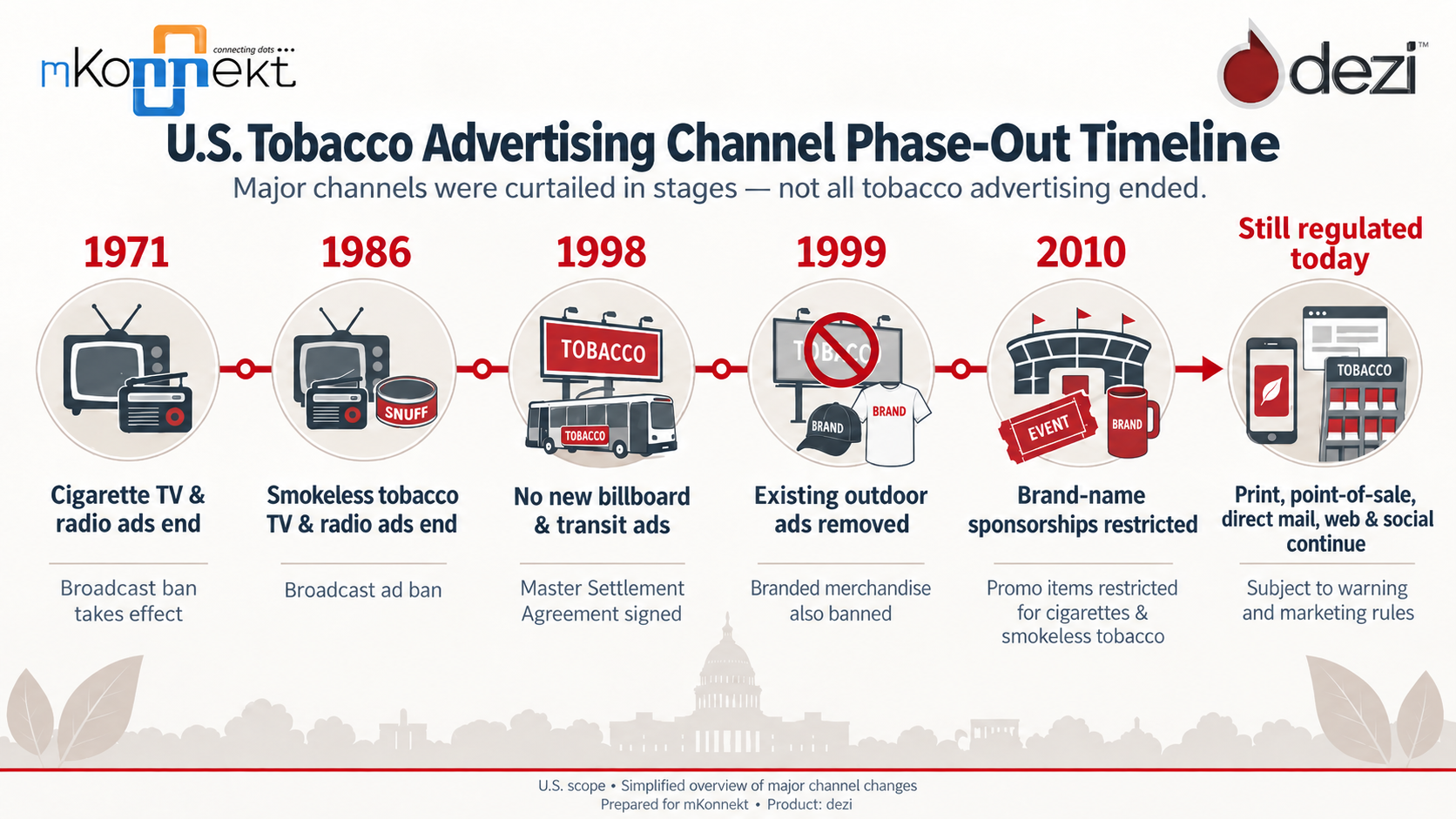
Over the years, marketing channels for tobacco manufacturers have dwindled and by 2020, broadcast, print, and sponsorship were gone. What remained was the store.
So the budget moved. In 2022, the largest cigarette companies spent $8.01 billion on advertising and promotion, and price discounts paid to retailers were the single largest category at $5.74 billion — 71.7% of the total. Including discounts paid to wholesalers, price discounting accounts for roughly 86% of all industry spending.
Manufacturers can't run a Super Bowl ad, so they compete on shelf price instead. Competing on shelf price requires proof that the contracted price was honored, the promotion ran, and real units moved at SKU level. That proof is produced by the POS (point-of-sale) system.
Retailers aren't being paid for
scan data as a favor. They're being paid because they're the last remaining media channel.
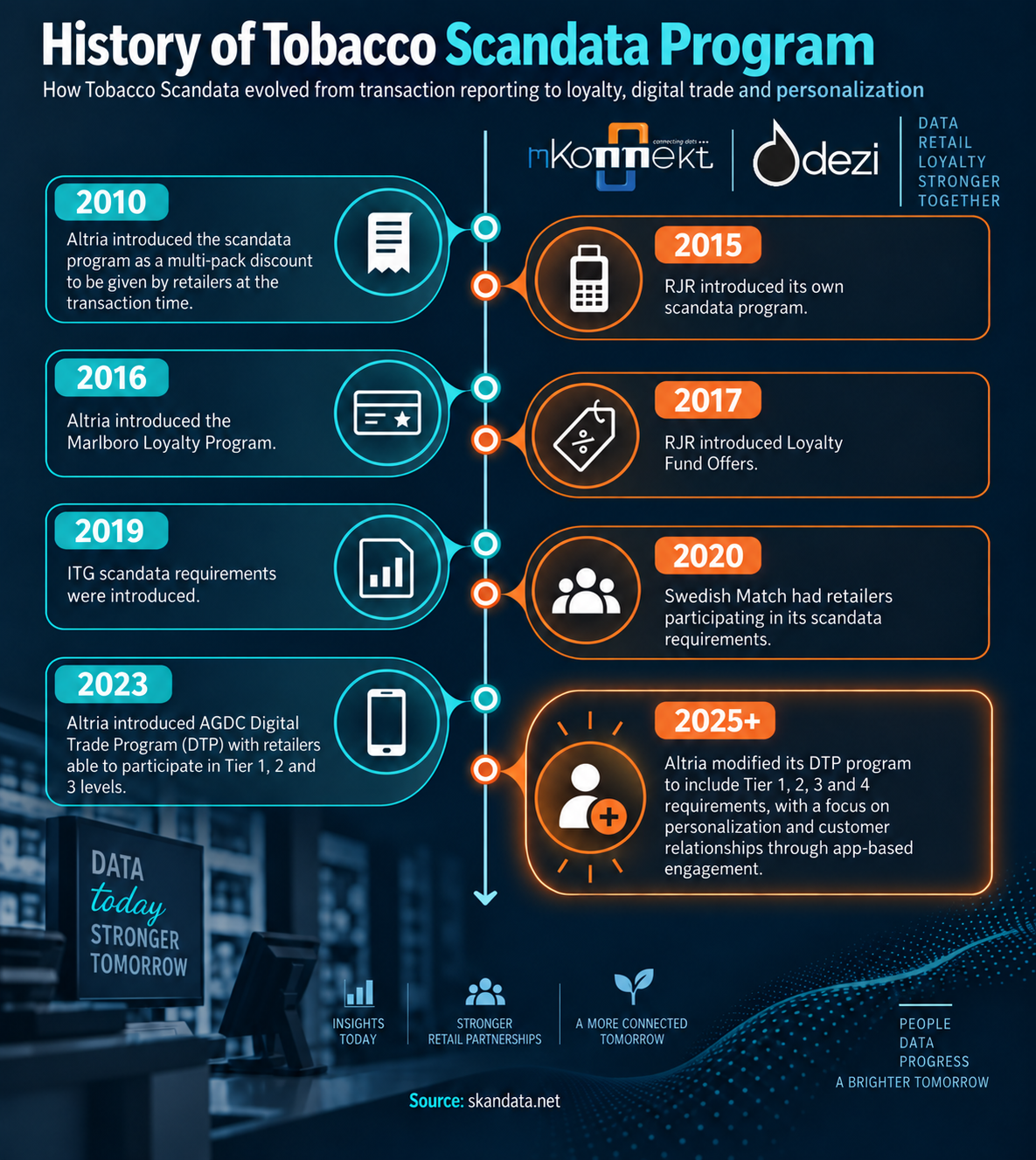
History of Tobacco Scandata Program
Tobacco scandata programs emerged over time as manufacturers increased their reliance on retail-level transaction data and retailer-funded promotional programs. By the mid-2010s, major manufacturers were formally incentivizing retailers to submit transaction-level scan data. Initially introduced by Altria other manufacturers have joined the bandwagon offering different kinds of discounts to tobacco customers.
- In 2010 Altria introduced the scandata program as a multi pack discount to be given by retailers at the transaction time
- By 2015 RJR have introduced their own scandata program
- In 2016 Altria has introduced Marlboro Loyalty Program
- In 2017 RJR has introduced Loyalty Fund Offers
- In 2019 ITG scandata requirements were introduced
- In 2020 Swedish Match has retailers participating in their scandata requirements
- In 2023 Altria has introduced AGDC Digital Trade Program (DTP) with retailers ability to participate in Tier1, 2 & 3 levels
- Starting 2025 Altria has modified its DTP program to include Tier 1, 2, 3 & 4 requirements with a focus on personalization and customer relationships through app
How Scandata has evolved over years?
Manufactures, Retailers & Consumers perspectives have evolved about scandata over the years.
Consumers
When the scandata program was introduced, consumers were viewing this as more of a temporary thing and might be discontinued at any time. What we have seen is that the customer behavior has changed with regard to scandata - they are now demanding that they get these discounts but also are looking for more personalized discounts based on their preferences. They would like to get new offers on their app as well notifications with regards to these new discounts.
Retailers
Retailers are viewing scandata as a core functionality of the PoS system that would help them in their business. For them, scan data increasingly supports three connected outcomes: revenue, execution and customer relationships. They want a system that supports multiple manufactures, that seamlessly integrates into pos system and applies discounts at the transaction level, able to report without any manual intervention and to reconcile so that they do not miss out on the payments front.
Manufacturers
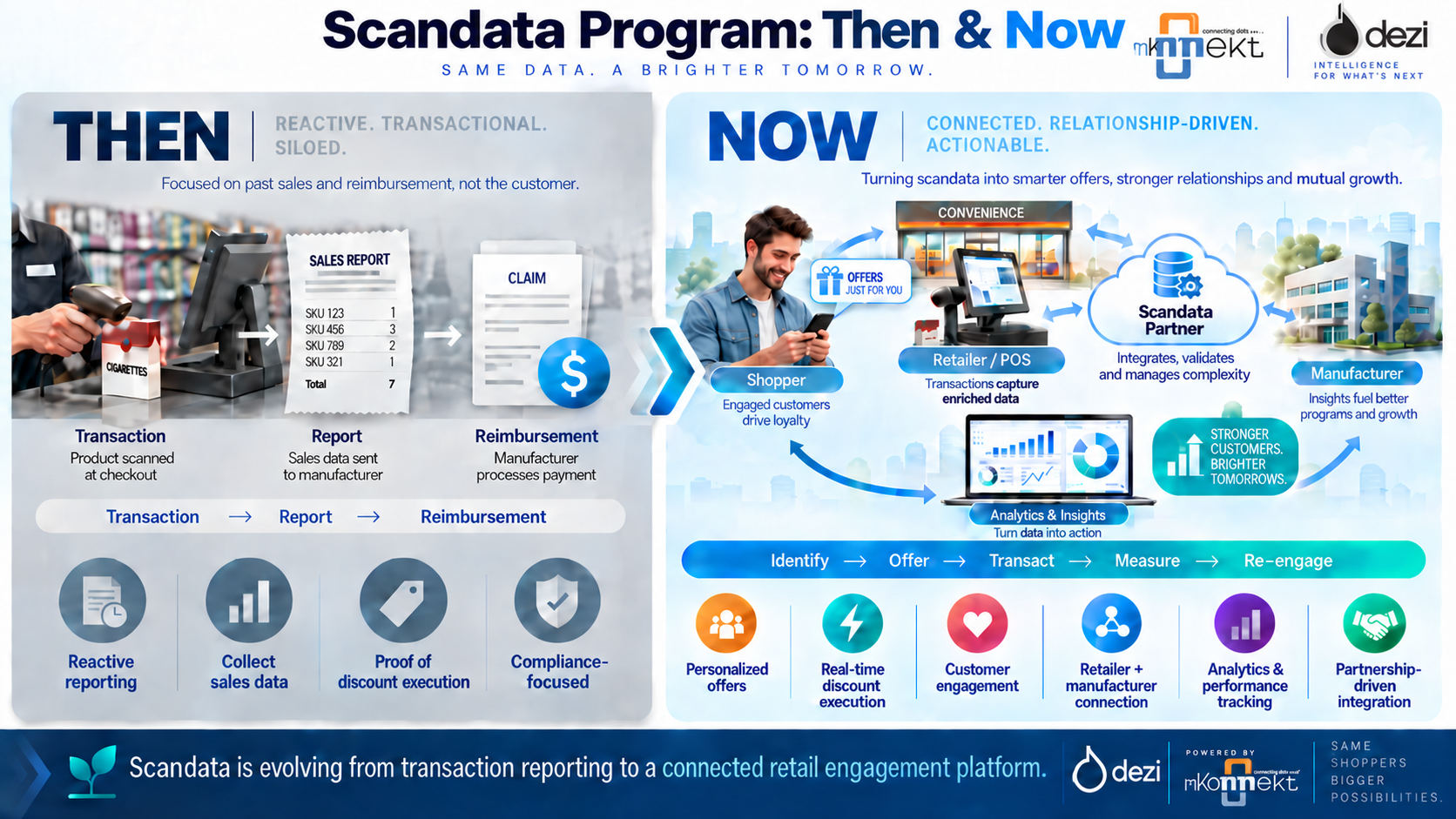
Over the years with dwindling marketing channels, we have seen a major shift on the manufacturer's front - usage of scandata as a strategic customer engagement tool rather than a reporting program.
- Manufacturers are building relationships with consumers through personalization, app engagement and complex promotional offers
- Altria changed the DTP requirements - starting 2025 they introduced Tier 4 requirements which talks about P+ (personalization +) - building 1-1 relationships with tobacco consumer
- Earlier scandata model can summarized as
- Transaction → Report → Reimbursement
- The emerging scandata model increasingly looks more like:
- Identify → Offer → Transact → Measure → Re-engage
What next for Scandata?
A shrinking customer base, changing consumer preferences, tighter regulation and fierce competition among retailers—combined with rapid advances in technology—will continue to change how manufacturers use scandata. What started primarily as a reporting and reimbursement tool is increasingly becoming a customer engagement and analytics platform.
We believe more manufacturers are likely to follow the broader direction Altria has taken by using scandata to support stronger customer relationships and more personalized offers. This will also make discount programs more sophisticated, with eligibility increasingly influenced by the customer, product, purchase history and promotional rules rather than a single discount applied to everyone.
AI could accelerate this evolution by helping manufacturers analyze transaction and engagement data, identify customer patterns and determine which offers may be most relevant. The future of scandata may therefore move beyond
reporting what happened toward helping manufacturers and retailers understand
what offer or interaction should happen next.