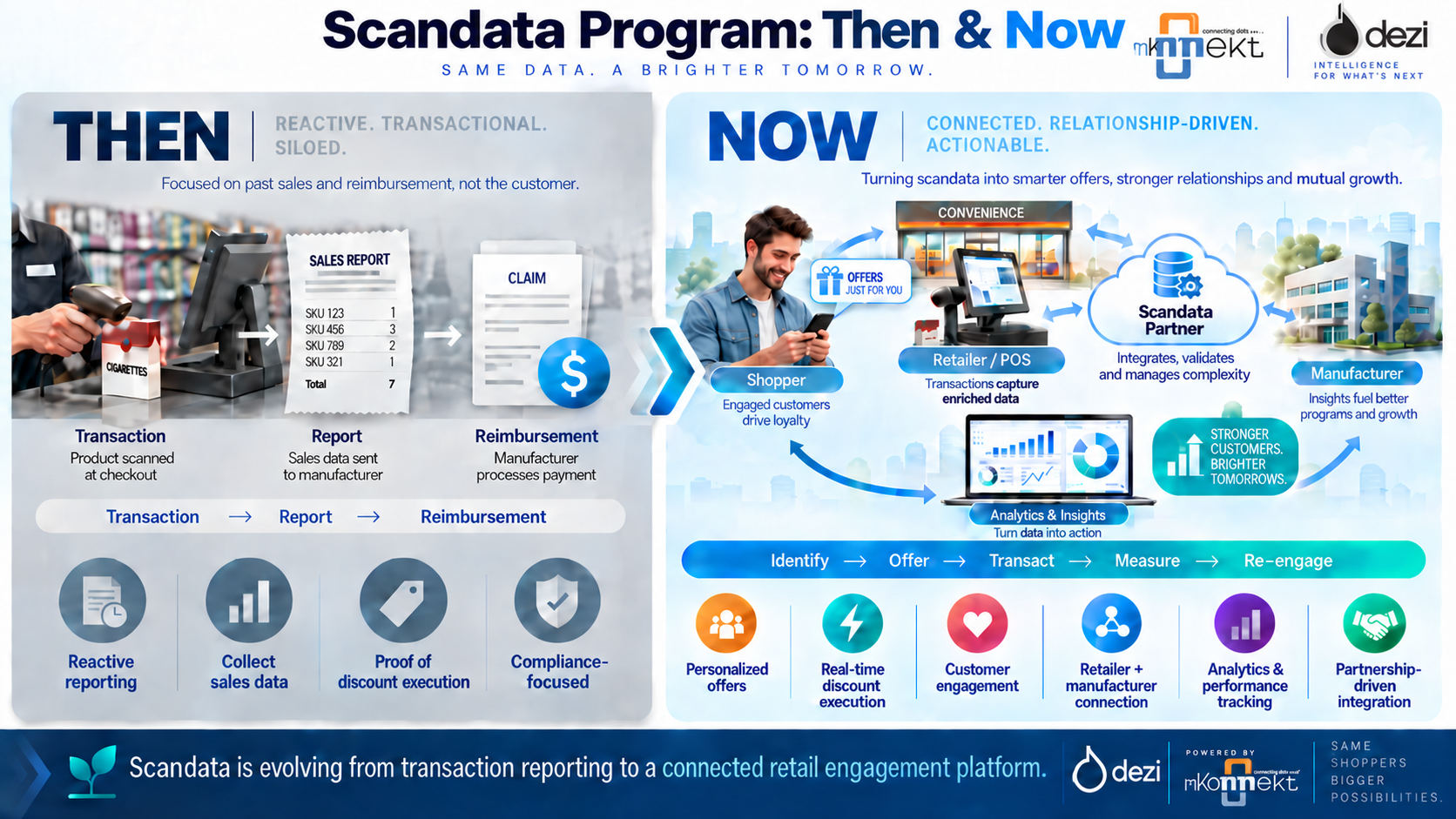
Many retailers process numerous transactions every month, and the data generated often goes unused. Purchase histories remain within POS systems, making it difficult to understand the shopper’s behaviour, identify loyal customers, or determine when regulars begin to disengage. This often leads to lower campaign performance, missed opportunities and decreased customer retention.
The Scandata Program emerges as a promising solution for this problem, known for translating barcodes into meaningful customer intelligence. Using data-driven insights, businesses can improve customer loyalty, optimise campaigns, and increase average basket value, resulting in long-term growth.
The 2026 guide highlights the working process of the Scandata program for retailers, so let’s get started....
How the Scandata Program Works
The working process of the tobacco scandata program for retailers has been divided into simple steps:
1. Product scanned: This is identified by Dezi and checked against the active program.
2. Age verification: Secondly, the age gate triggers before sales via 2D barcode scan or EAIV, where your tier requires it.
3. Discounts found & applied automatically: Dezi checks every applicable offer buydown, multipack trigger, digital and paper buydown, and personalization+ offer tied to the customer history & applies the coupon.
4. Transaction closed: The sale completes with the full record captured: UPC, price paid, quantity, timestamp, register, store, loyalty ID, and the promotional flag that makes the discount reimbursable.
5. Weekly report generated & submitted: Transactions are formatted according to each manufacturer's specifications and transmitted on their schedules. Altria, RJR, ITG and the rest each receive their own file, in their own format, on their own deadline.
6. Back-office report generated for
reconciliation: A parallel report goes to you, showing what was reported, what was discounted, and what you're owed, so when payment arrives, you have something to check it against.
The Scandata Technology Stack: Discounting Engine, POS, Reporting Engine, Back Office & Support
1. The Discounting Engine:
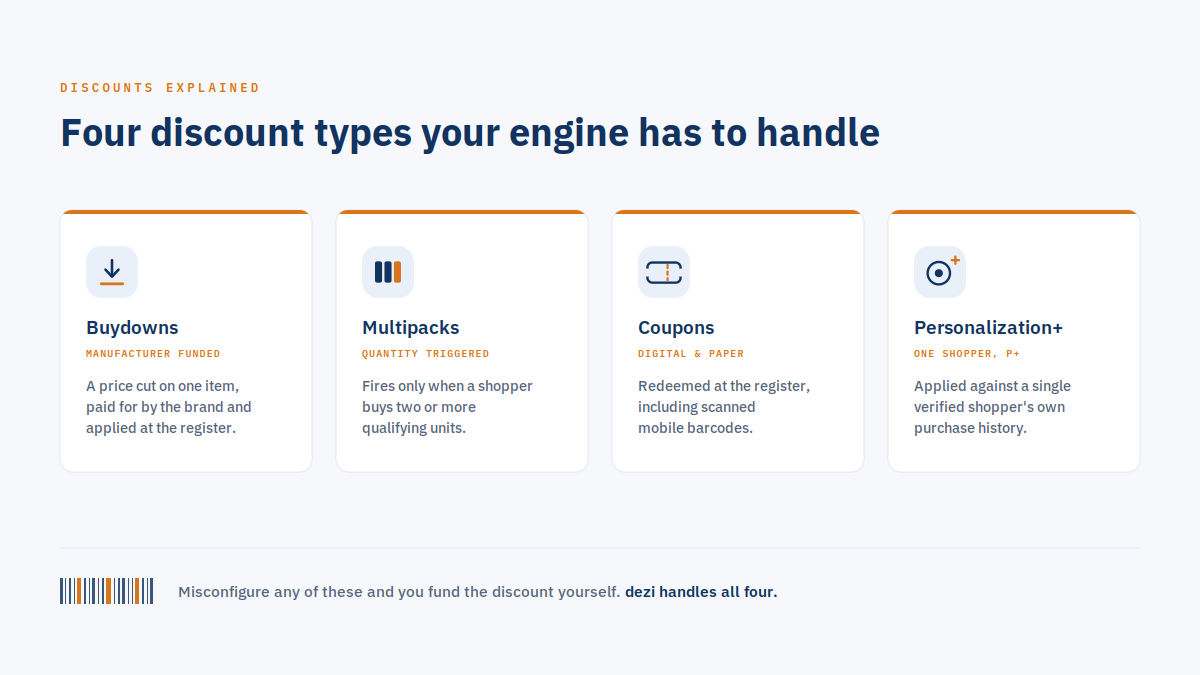
This applies the right discount to the right SKU at the right moment, within the right budget. Four discount types have to be handled natively: buydowns, which are simple manufacturer-funded price reductions on a single item; multipacks, triggered when a customer buys two or more qualifying units, powerful but the most commonly misconfigured promotion in the industry, since setting the trigger wrong means you either fail to fund or over-discount into your own pocket; digital and paper coupons, including mobile barcodes scanned from a customer's phone; and Personalization+ offers, applied against a specific verified consumer's purchase history rather than a blanket store-wide price. Dezi handles all four and enforces budget caps so you never overspend a funded allocation, and manages promotional windows automatically so expired offers stop firing on day one rather than day nine.
2. The POS Layer. Generic retail POS systems cannot meet tobacco scandata requirements, because each manufacturer demands data in its own precise format Altria's Digital Trade Program uses different file structures than the RJ Reynolds or ITG programs. Rather than force a rip-and-replace, dezi integrates with your existing platform to enable full participation in Altria DTP Tiers 2, 3 and 4, RJR scandata programs, and ITG reporting, including Korona POS and PC America, RMH POS, StoreTender, and Clover Station devices via the Clover app market. This layer also carries the age gate, which is no longer optional at higher tiers: dezi handles age validation technology at the register using a 2D barcode scanner, and electronic age & identity verification where the program demands it.
3. The Reporting Engine. The unglamorous system that determines whether you actually get paid. It formats every transaction to each manufacturer's spec, transmits on schedule, monitors for acceptance, and catches rejections before the payment window closes. A rejected file nobody notices is a month of unpaid incentives, and a store whose connection silently goes offline often doesn't discover it for two cycles. Dezi automates submission across all supported manufacturers, monitors connection health, and flags failures rather than letting them accumulate.
4. Back Office. This turns scandata from a compliance chore into a management tool. Reconciliation answers what each manufacturer actually paid you against what they owed very few retailers check, and it is the fastest way to find money. Fund tracking shows how much of your promotional allocation you've spent and whether you're pacing to leave any unclaimed. Category insight gives real velocity by SKU, daypart, and store, showing which facings earn their space and which are dead inventory absorbing capital. Multi-store roll-up gives operators one view instead of one login per manufacturer per store.
5. Support. The four systems above only pay if they're configured correctly and stay that way, which is where most retailers actually struggle. Our team handles enrollment paperwork and provider designation with each manufacturer, configures your feed and verifies the first successful transmission rather than assuming it, and trains your staff on the register workflow before your first reporting period. After launch, we monitor your connection health, alert you when a file rejects or a promotion misfires, and work the reconciliation with you each cycle. Program rules, tier requirements, and file specs change without much warning; we track those changes and update your configuration so you aren't the one discovering a spec revision through a missed payment.
Why Tobacco Manufacturers Pay Retailers Instead of Buying Ads
Most retailers have never had this explained, and it's the key to understanding why the money is so reliable.
Over five decades, tobacco manufacturers lost nearly every marketing channel they had:
And the money went where it was supposed to. Today, roughly 96% of tobacco marketing spend. At present, the tobacco market spends about 96% of its budget, of which $8.4 billion flows through the POS almost entirely to fund price discounts and coupons.
Nearly every marketing dollar in this industry now moves through the register. That's the logic behind scandata. Manufacturers can't run a Super Bowl ad, so they compete on shelf price instead, and competing on shelf price requires proof. Proof you honored the contracted price, proof the promotion ran, proof of real sell-through at the SKU level. Your POS is the only thing that can produce it.
One flag: the source mixes two different figures, 96.6% and "over 97%", drawn from different studies covering different product categories, and pairs $8.4 billion with the FTC's $8.01 billion.
You are not being paid for data as a favor. You are being paid because you are the last remaining media channel.
Which Tobacco Manufacturers Run Scandata Programs
The tobacco Scandata program is run by numerous operators highlighted as follows:
Manufacturer What they cover program note
1. Altria (AGDC) — Philip Morris USA, U.S. Smokeless Tobacco, Helix/on!
Marlboro, Copenhagen, Skoal, on!
Runs the Digital Trade Program (DTP), the most structured and most lucrative framework in the category
2. RJ Reynolds (Reynolds American)
Newport, Camel, Pall Mall, VUSE, Grizzly
Runs the Digital Partnership Program (DPP), with level-based technology requirements, loyalty and multi-pack discount reporting, and access to Joint Business Funds (JBF) and Customer Support Funds (CSF)
3. ITG Brands
Winston, Kool, Salem, Maverick, blu
Requirements broadly parallel the Reynolds program, with loyalty discounts, mobile coupons, and multi-pack discount reporting
4. Swedish Match
ZYN, General snus, White Owl, Game
Modern oral leader; scandata reporting increasingly central to trade support
5. JTI (Japan Tobacco International)
Logic, Natural American Spirit (intl.), Nordic Spirit
Growing U.S. trade program footprint
How Tobacco Scandata Program Benefits the Retailers
The Tobacco Scandata program benefits retailers in numerous ways, highlighted as follows:
- Direct manufacturer payments: Enrolled retailers get contracted payments after providing item-level sales data. It is separate revenue provided for participation and reporting, as a monthly cycle instead of a promotional amount.
- Margin on a category: For many convenience retailers, scandata payments account for a substantial share of what tobacco actually contributes to the bottom line.
- Access to higher tiers and better pricing: Meeting the requirements for a higher tier improves your buy-side position, which lets you compete on shelf price against nearby stores rather than losing traffic to them.
- Guaranteed promotional funding: You run the promotion at the required price, report it, and recover the difference, so participating in manufacturer promotions stops being a margin decision.
- Operational visibility: Retailers routinely discover overstocked slow movers and understocked fast movers once the SKU-level picture exists.
- Verified age compliance infrastructure: AVT and EAIV requirements push you onto verification systems that reduce failed-inspection risk. The compliance benefit outlasts any individual program cycle.
- Customer database: Loyalty enrollment converts anonymous tobacco transactions into identifiable, reachable customers in a category where repeat purchase frequency is unusually high, and retention is worth more than acquisition.
- Competitive parity: In a category where customers select stores primarily on price, non-participation is a compounding disadvantage rather than a neutral choice.
Where Retailers Lose Scandata Money
1. Enrolled at Tier 1 & stopped: The base scan payment is the smallest bucket. Tiers 2–4 are where the economics change.
2. Silent transmission failures: A sync goes offline. Files stop. Nobody notices for six weeks. If your store isn't submitting files, the manufacturer doesn't pay, and this most commonly happens because the connection has gone offline.
3. Misconfigured multipacks: Steps done out of order, wrong trigger quantity, discount funded from the wrong bucket. The customer gets the deal; you eat it.
4. Unclaimed promotional funds: Allocated budget expires unspent because nobody was tracking pace.
5. No reconciliation: Payment arrives, gets deposited, never gets checked against entitlement.
6. One manufacturer only: Running Altria but not RJR, ITG, Swedish Match, or the modern-oral challengers, leaving whole revenue streams untouched.
The Bottom Line
The tobacco scandata program is the rare arrangement where a retailer gets paid for work they are already doing. You are ringing up the transactions regardless. The only question is whether that data is being captured cleanly, transmitted correctly, discounted accurately, and reconciled honestly or whether it's evaporating between your register and the manufacturer's validation system.
Come back to the three numbers. 55.5 million adult consumers. 21.5% of everything convenience retail sells. $8.4 billion in marketing spend, 96.6% of it aimed squarely at the point of sale.
That third number is not a statistic about the tobacco industry. It's a statistic about you. Nearly every marketing dollar in a multi-billion-dollar category now flows through a register — and some of it is addressed to yours.
dezi, powered by mKonnekt, is built to make sure it arrives. One integration. Every major manufacturer. Tiers 1 through 4. Automated reporting, compliant discounting, verified age gating, and back-office visibility — without changing how you run your store.
Ready to see what your store is currently leaving on the table? Scan the QR code on our in-store materials, or reach the dezi team at 1-888-294-3394 (Mon–Fri, 8 AM–10 PM EST).
Frequently Asked Questions(FAQs)
1. Do I need to replace my POS to join a scandata program?
Usually not; your system needs to capture item-level detail: SKU, price, quantity, timestamp and Dezi integrates with existing platforms including Korona, PC America, RMH, StoreTender, and Clover. A standalone card terminal or a register that rings tobacco on a single department key won't qualify, but a capable POS rarely needs replacing.
2. How long does enrollment take before the first payment arrives?
Manufacturer approval is the longest step and typically drives the timeline. Once accounts are open, provider designation, feed configuration, and age verification can move in parallel. The most common cause of a delayed first payment isn't approval; it's an unverified feed or incomplete EFT details.
3. Can I participate with more than one manufacturer at the same time?
Yes, and you should. Each program is administered separately with its own file format, schedule, and identifiers, which is why running several manually goes wrong. A single integration handles all of them and is the difference between one revenue stream and five.
4. What's the difference between the tiers, and is a higher tier worth it?
Tiers set both your payment rate and your promotional pricing position, and they carry requirements — AVT at Tier 2, EAIV at Tier 3 and above. Tier 1 is the smallest bucket by a wide margin, so for most stores the technology investment required to reach Tier 2 or higher returns quickly.
5. Why does reconciliation matter if the payments arrive automatically?
Because what arrives and what you're owed are frequently different numbers. Unmapped SKUs, buydowns that were never flagged as promotional, and rate tiers applied below what you earned all reduce payment silently. Caught within the same cycle, these are usually correctable; caught six months later, they generally aren't.